Monday, March 28, 2011

Mollusk Discovery

Scallops ():

(picture by Augsburg.edu)
 The common name is Bay Scallop and the scientific name is Aequipecten irradians.

Taxonomy
Kingdom: Animalia
Phylum: Mollusca
Class: Bivalve
Order: Anisomyaria
Family: Pectinidae

Video
Link (:
This is a link to a vidoe showing a scallops swimming.
Characteristics
There are 300 different species of scallops in the ocean worldwide.One "cool" charateristtic of the bay scallop is that they have sixty eyes along the edge of their mantle to detect motion.  Also if one of their eyes was to be injured or lost, they can easily regrow it.
(picture taken by Augsburg.edu)
 This is a close up picture of the eyes on the scallop's mantle.

(picture by Augsburg.edu)
Another neat picture of the scallops's eyes. Although these eyes may not produce a clear image, they are quick on detecting motion.
(Picture by mywfc.com)
The second "cool" characteristic about the scallop is that they have the ablility to swim. This is an unusual trait since most bivalve's lack this trait. They use this triat to propel themsevles away from their predators.

Tuesday, March 15, 2011

Crustaceans and Echinoderms

Crustaceans

Clawed Lobsters
Kingdom:Animalia
Phylum:Arthropoda
Subphylum:Crustacea
Class:Malacostraca
Order:Decapoda
Infraorder:Astacidea
Family:Nephropidae


Hermit Crab

  • Their skeleton is on the outside which is known as their exoskeleton.
  • They are bilateral symmetry, which means both sides are the same.
  • Also crustaceans have segmented appendages (legs).
Echinoderms
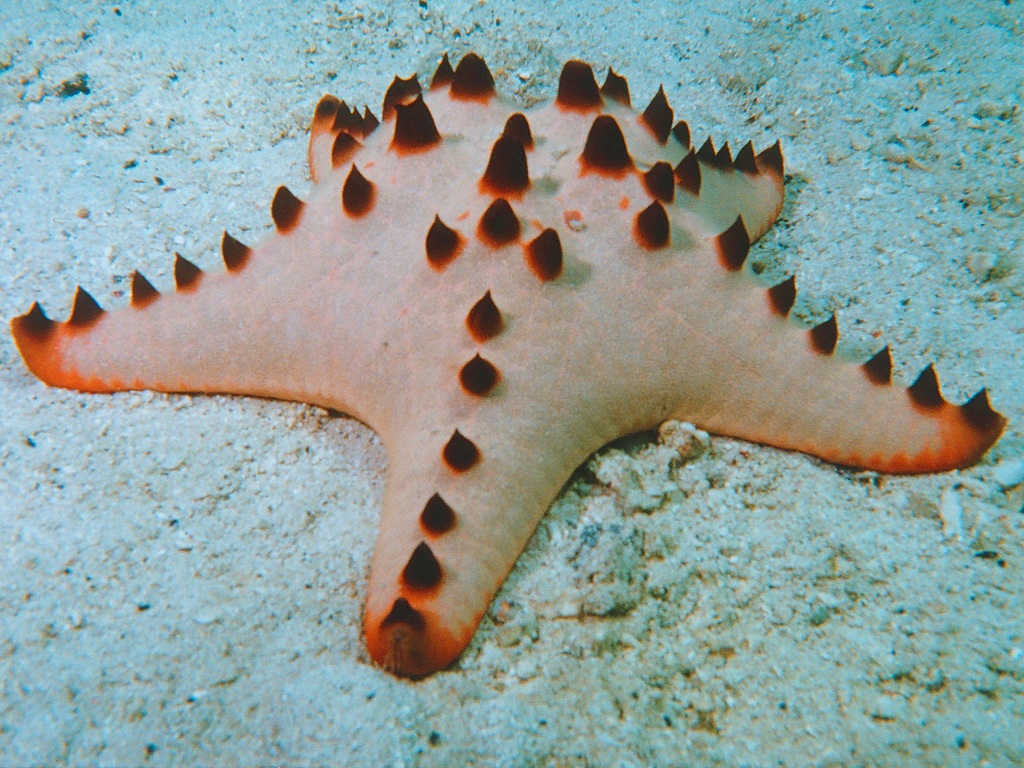
Horned Starfish
Kingdom:Animalia
Phylum:Echinodermata
Class:Asteroidea
Order:Valvatida
Family:Oreasteridae
Genus:Protoreaster
Species:P. nodosus
Granulated Sea Star

Sea Cucumbers
Kingdom:Animalia
Phylum:Echinodermata
Class:Holothuroidea
Order:Aspidochirotida
Family:Holothuriidae
Genus:Holothuria
Species:Holothuria pardalis

  • They have endoskeleton which means that their skeleton is on the inside.
  • Echinoderms have no body segments
  • Also the have radial symmetry ( which means it has more than 2 lines of symmetry).

Video Link (:


Thursday, March 3, 2011

Signs of Spring (:

 On the first stop of our outdoors adventure, we stopped at the perimeter of the feild. It was very sunny outside and I could feel the hot sun on my skin but from the trees at the wood line casted a shadow and made it chilly. In a distance you could hear birds chirping. The sign of spring I saw was the Honeysuckle growing on this plant.
Also this is another sign of spring I found at the first stop on our outdoor advetnure. This sign was buds sprouting out of the tree.
The second stop on our outdoor adventure was the shoreline of the pond. The sign of spring I found there was a little tree's buds starting to sprout out. It was very windy outside which made it were chilly. You could hear the leaves and trees swaying together from the wind. Even though it was 43 degrees outside, from the wind chill it felt like it was 32 degrees.
 The third stop on our adventure we stopped at that other side of the pond. For one sign of spring, I found a tree sprouting buds. Another sign of spring I found was a Alder Catkins tree, giving of pollen. It was still really windy outside. And we were near the bus garage so we heard moving vechiles and backing up beeps.
The last stop on our outdoor adventure was outskirts of the road leading to the bus garage. There I found another vine that had Honeysuckle growing on it. It was still very windy outside. The wind made it very chilly outside. But the sun was shining and there were no trees around us casting shadows so the sunlight was warm against my skin.

(All pictures taken by Brittany Henslee)

Bioflim Smulation at the G.C Marine Reserve


Dear Momma (:
Today in class Mrs. Richardson had us do a exciting lab. Of course it was going to be good because it invovle food but also it was fun becuase it a good way to learn new materal.

First she had us read over lab to make sure we understood everything we were doing. The graham cracker represented the biofilm plate which is something that a bunch of life in the ocean can settle on. These biofilm plates are used to collect organism. Then we spread icing on the graham cracker which represent a type on slim that is placed on the biofilm plate so that organism can stay attached to the plate. Next we placed a Life Saver onto the middle of the graham cracker to represent that bolt that would be used on the bioflim plate to make sure it does not move and it attached to the subtrate. Now we used red sugar crystals as red coralline algae, brown long johns as diatoms, rainbow sprinkles and marshmallows as barnacles, rainbow long johns as coral and blue or dreen dots as oysters. We sprinkled each organism over the graham cracker on at a time. This way it shows you how when the organism in the ocean land on the biofilm plates it is all at random.


Now that we had all the organisms on the graham cracker I placed marshmallows on to represent the barnacles when they grow up.
The reason Mrs. Richardson had us do this lab is to show us all the diveristy in zonations and how they are always changing.
(All pictures taken by Brittany Henslee)

Tuesday, February 22, 2011

Algae in the Cupboard (:

  I found the algae alginates in UGG water proof.
 I found the algae carrageenan in tooth paste.
I found the algae alginates in Ben and Jerry's ice cream

The reason I think Mrs. Richardson had us look in our cupboards for these particular algae was to show us how they are commonly used in everyday items and how they are important.
(All Pictures taken by Brittany Henslee)

Plankton War (:

Matt and I had a hard time at first deciding on how to design our plankton. The goal was to create something that would sink but not sink all the way. So we decided to create something with a flat surface. Then we took wooden popsicle sticks and broke them in half and layed them across the bottom of our surface. By adding the wooden popsicle sticks, we knew wood would float so we used this to help it float. Next we added buttons onto the top of the surface to add some weight to our plankton. Even though our plankton did not win. We were still one of the top planktons (:
(Picture taken by Mrs. Richardson)

Monday, February 21, 2011

Adventure 5 & Bird Watching (:

 At the first site when we were sitting by the pond listening and watching out for birds, Mrs. Richardson had us sit quite for 5 minutes and believe me it wasn't easy. But in this time I has 2 black vultures, 2 crows and 1 cardinal. I could hear birds chirping and  a horn beeping.
(did not have any pictures for this site)
 This is a salamander one of our classmates found under a gross old tree. It was very cool and windy outside on Friday. Mrs. Richardson is holding the salamander in this photograph.

 We also found this mold at the same site we found the salamander. It was surrounding the bottom of a tree that had fallen over. 
(pictures taken by Brittany Henslee)
 
 This was a picture taken by Mrs.Richardson. In this picture you can see it is a warbler. It was sitting on top of a pine tree.

Tuesday, February 15, 2011

Adventure 4 (:

  Site 1
Our first stop on adventure 4, was the shore line on the pond. It was very cold outside and we were looking for algae in the pond water. Inside the water I found phytoplankton and it was algae. It was green and icky looking.
 Site 2
Right before our second stop on our adventure, Mrs. Richardson found something unusual on the ground. At first I thought maybe it was some type of bark that was all wrapped up. But she informed us that it was a old turtle egg shell.

 Site 3
The third stop on your adventure was at the creek down in the woods.  This is a picture of some algae I found along the creek bottom. It was very cold and windy outside.
On our way back into the school, I saw a feather lying on the ground. Since it was so neat looking, I decided to take a picture of it (:

(All pictures taken by Brittany Henslee)

Wednesday, February 9, 2011

In-class Observations (:

This is a picture of a worm that we found in the pond outside of the school. This plankton is known as zooplankton. It is bigger than 1 mm which makes it macro.
This is a closer up picture of the worms body. As you can see the worm has little hairs along its body which acts as little legs to help swim. Also this allows them to float.


This is a picture of dead forams skeletons which are zooplankton and holoplankton. This sand is found in Star Beach, Japan.

This is a observation of phytoplankton. They are responisle for the oxygen we breath. This plankton is microscopic.

Friday, February 4, 2011

Adventure 3 (:

Site 1
The first stop on our adventure was a little creek right outside the bus garage. It was very cold outside and very damp from the previous rain we had this week. In the creek we saw pollution. Someone had thrown out some cans in the creek

Site 2
The second stop was the shore line against the pond. It was still very cold outside and it was so cold that some of the pond had frozen over. There was lots of grass against the shore line. There was not much sign f animal life. The only animal life we saw that day were a couple of geese across the pond.

Site 3
The third stop on our adventure was the pond its self. Across the pond there were a couple of geese. It was still very windy and cloudy outside. This made it very cold.


 Site 4
The fourth stop on our adventure was outside of the school, at the green doors. There were a couple of trees. On the trees there was some algae and mold looking stuff on the bark.

(all pictures by Matt Apperson)

Wednesday, January 26, 2011

Observation Site #4 Adventure 2

This was our last stop before we went back into the school. Mrs. Richardson had us be very quiet so we did not scare away the geese. It was very windy outside and as we got closer the pond it got colder.

(Pictures by Brittany Henslee)

Observation Site #3 Adventure 2

This was the thrid spot on our adventure outside. I found this tree in the woods with a hole in it, concluding something must have been living in there.

This is another picture we took at the creek. Inside this hole is where crawfish live.

(Both pictures by Brittany Henslee)

Observation Site #2 Advetnure 2

This was our second spot on our way out into the woods. There was a tree that had fallen over and had a hole at the bottom of it. The hole looked as if an animal had made it. It was also very windy and cold outside. You could hear birds in the distance.

(Picture by Brittany Henslee)

Observation Site #1 Adventure 2

Site 1
This was our first site. Along the creek there were many thorn bushes and lots of leaves on the ground. Under the wood (to the left of the picture) I saw an animal swim under it. Also in the distance I noticed a birds nest in a tree.

(Picture by Brittany Henslee)

Thursday, January 20, 2011

Observation Site #4


Spot 4
At the fourth spot you could hear the birds in the distance. It was sunny outside. There were no trees around us so it was very windy and cold.

(Picture by Michael Laird)

Observation Site #3

Spot 3
At the third spot it was very quiet and the grass was frosty. It was very windy outside and sunny.

(Picture by Michael Laird)

Observation Site #2


Spot 2
At the second spot there was lots of damp leaves on the ground. The sun was shining and shadows were cast from the trees. As we walked in the woods, you could hear the leaves crunching under our feet. Also on our adventure into the woods, there were a lot of dead trees.

(Pictures by Michael Laird)

Obseveration Site #1

(

Spot one
At the first it was very cold and shady. The leaves were very slippery and you could hear birds in the distance.

(Pictures by Brittany Henslee)